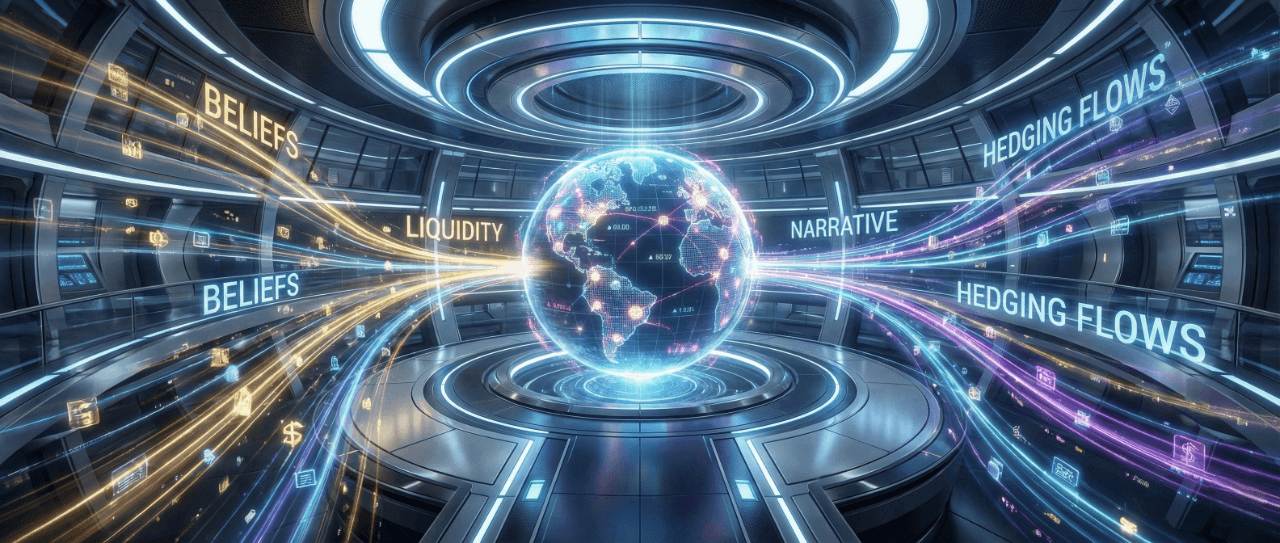
If you strip markets to their core, they’re a machine for answering one question: What does the world believe will happen next - and how strongly?
Prediction markets are the purest form of that machine: they convert information into a price with minimal storytelling overhead.
Why prediction markets feel “more real” than polls
- Skin in the game: participants put capital behind beliefs, not vibes.
- Continuous updates: prices adjust in real time as new information arrives.
- Aggregation: the market compresses thousands of partial signals into one readable number.
How this impacts money markets
Money markets care about rate expectations, risk appetite, and regime shifts.
When prediction markets become liquid enough, they can influence how capital hedges and reallocates:
- Narrative velocity increases: a visible price accelerates consensus formation (or panic).
- Hedging becomes simpler: participants can hedge discrete outcomes instead of proxy instruments.
- Liquidity follows attention: more traders monitor the same “truth gauge,” making it a coordination point.
The second-order effect: markets start trading “belief curves”
Once a belief has a price, traders stop asking “Is it true?” and start asking: “How fast will belief change, and who is late?”
“When information becomes liquid, volatility is often just belief re-pricing.”
What to watch next
- Better market design (tight spreads, resilient oracles, clearer settlement).
- More institutional participation as compliance and custody mature.
- More integrations: wallets, trading terminals, and AI agents consuming these prices as “truth signals”.
Prediction markets won’t replace money markets - but they will increasingly shape the information that money markets trade.
Read next
More posts selected by topic overlap and recency.

Kalshi & Polymarket: Why Prediction Markets Are Going Mainstream
Two platforms helped prediction markets break out of the niche. Their momentum is powered by better UX, clearer settlement, and tech stacks that make “markets for truth” feel usable.

Bots as Advisors: Why Human Judgment Still Produces Alpha
The “MEV problem” is often a symptom. The real disease is fire‑and‑forget bots with no learning loop. The edge lives in feedback, friction, and human-in-the-loop execution.