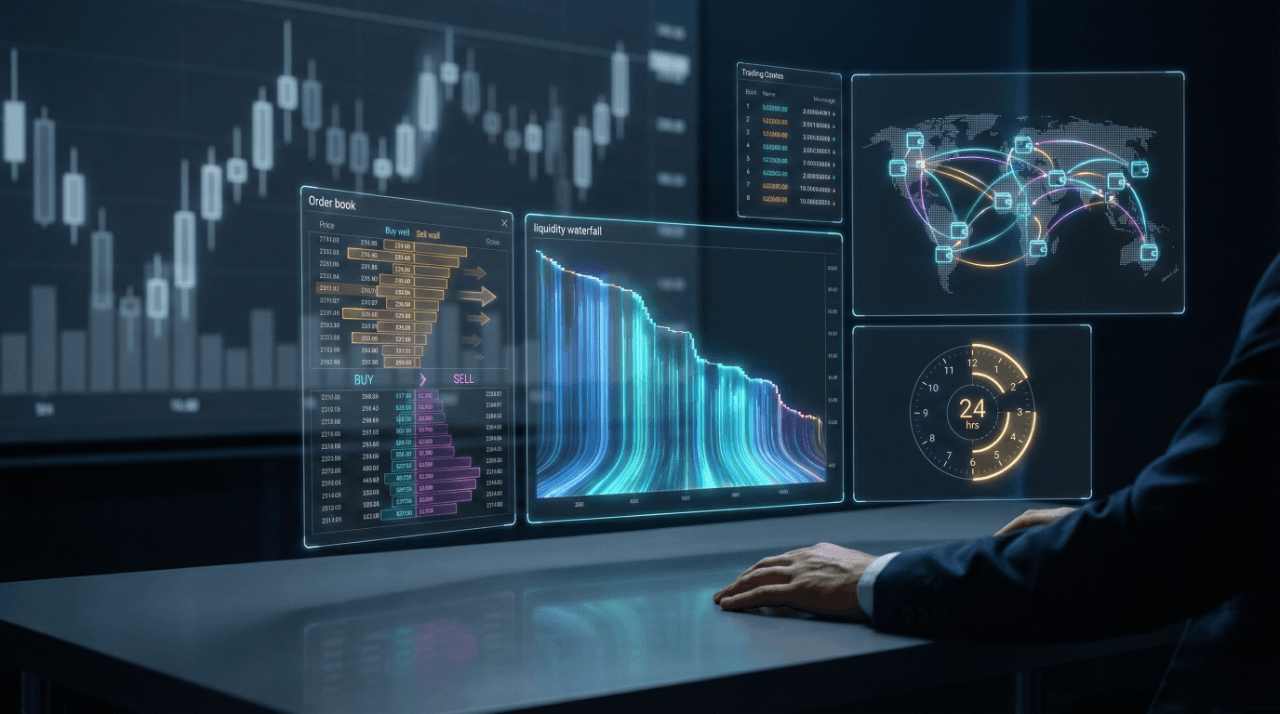
I spent a few days reverse‑engineering a simple question: How does AI spot trading signals that humans consistently miss?
What surprised me wasn’t the complexity - it was the simplicity of what most “AI trading” products actually do.
The mistake: treating indicators as “signals”
Indicators are summaries of the past. They’re useful for context, but they rarely capture the mechanism of why price moves next.
A candle doesn’t print because RSI crossed 70. It prints because liquidity shifted and someone with size pushed through a level the market couldn’t absorb.
What “real” signal detection watches instead
- Liquidity cascades: when institutional flow enters a pool and the market re-prices quickly.
- Order book micro-movements: pressure changes that hint at the next candle before it prints.
- On-chain wallet patterns: early accumulation and distribution signals you can’t see on a chart.
- Time-of-day regimes: certain players are active at predictable times, with predictable behavior.
Why this works: it’s causal, not cosmetic
The common thread is causality: these signals describe market mechanics, not market drawings.
When you model the how behind price movement - absorption, imbalance, crowd timing - you start predicting, not reacting.
“Fast execution of bad logic is still bad logic.”
A practical framework for building “signal stacks”
- Start with one signal family (liquidity, order book, on-chain, timing).
- Define the decision
beforeyou see the outcome (no hindsight labels). - Measure how often it improves your next action (entries, exits, sizing).
- Only then combine signals into a stack - and weight them by regime.
If you’re building trading automation, don’t optimize for speed first. Optimize for intelligence - then let speed amplify it.
Originally shared on LinkedIn: Benul Nethmitha’s post.
Read next
More posts selected by topic overlap and recency.

Bots as Advisors: Why Human Judgment Still Produces Alpha
The “MEV problem” is often a symptom. The real disease is fire‑and‑forget bots with no learning loop. The edge lives in feedback, friction, and human-in-the-loop execution.
Kalshi & Polymarket: Why Prediction Markets Are Going Mainstream
Two platforms helped prediction markets break out of the niche. Their momentum is powered by better UX, clearer settlement, and tech stacks that make “markets for truth” feel usable.